ARTICLE
How to Build a Payroll System for Home Care Agencies with Mixed Hourly and Revenue-Split Pay Structures
Home care agencies that pay some staff hourly and others on a revenue-split basis face tangled payroll logic that's slow and error-prone to calculate manually. This article shares how we built a payroll system for a home care agency that untangled both pay structures into a single system, cutting payroll processing time by at least 80%.
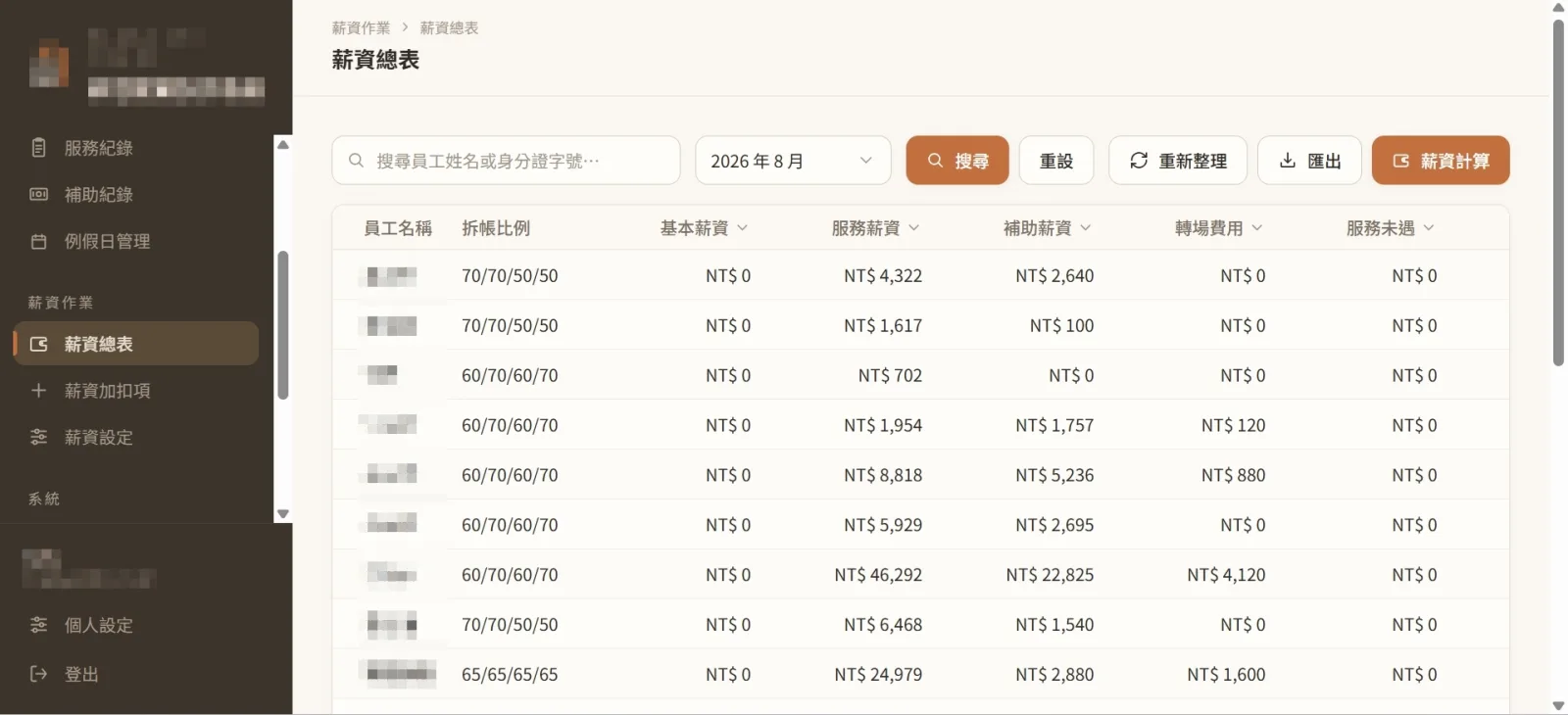
Why do mixed hourly and revenue-split pay structures make payroll so complicated?
Payroll structures at home care agencies are often more complex than in other industries. When an agency has both hourly staff and revenue-split staff, the two calculation logics have to be applied side by side, layered on top of service hours, service codes, and other variables. This makes payroll processing at the start and end of each month one of the heaviest burdens for administrative staff.
The agency we recently worked with was a textbook case of this: a larger organization where caregivers were paid under both hourly and revenue-split models. The two pay structures ran independently, and cross-checking them was extremely time-consuming and prone to manual errors. Previously, calculations relied on Excel formulas and manual comparison — and because formulas were scattered across multiple files, updating one file never synced automatically with the others.
How did we untangle the hourly and revenue-split calculation logic?
Our approach was to first break down the previously tangled calculation process step by step, clarifying the underlying logic behind each pay scenario for both hourly and revenue-split staff. We then translated that logic into rules the system could execute, building it into the back end.
The key wasn't simply porting Excel formulas into the system as-is — it was first verifying the logic itself was correct, then letting the system calculate automatically from there. When rules need adjusting, only the back-end settings need to change; there's no need to rewrite formulas or worry about inconsistent versions across multiple files.
Results after implementation
After implementation, payroll work that once required significant time cross-checking at the start and end of every month saw processing time drop by at least 80%. Administrative staff were freed up from repetitive calculation work to focus on tasks related to care quality.
Frequently Asked Questions
Q1: Can a home care payroll system handle both hourly and revenue-split pay at the same time?
Yes. We first map out the pay logic for both hourly and revenue-split staff within the agency, break it down into independent calculation rules, and then integrate both into a single system — so staff under either pay structure can be processed correctly in the same workflow.
Q2: Can the calculation rules for hourly and revenue-split pay be adjusted later?
Yes. Rules are stored in the system's back end, so if payment standards change in the future, only the settings need to be updated — no need to rewrite code or touch existing calculation formulas.
Q3: How much payroll processing time can be saved after implementation?
Based on this case, processing time dropped by at least 80%, turning what was once a high-workload task concentrated at month-start and month-end into a predictable, routine process.
